The Guardian of Gold and Water:
The Story of Francesco Martino
There are stories that need no grand celebration. It is enough simply to put them in their proper context. Francesco Martino’s is one such story.
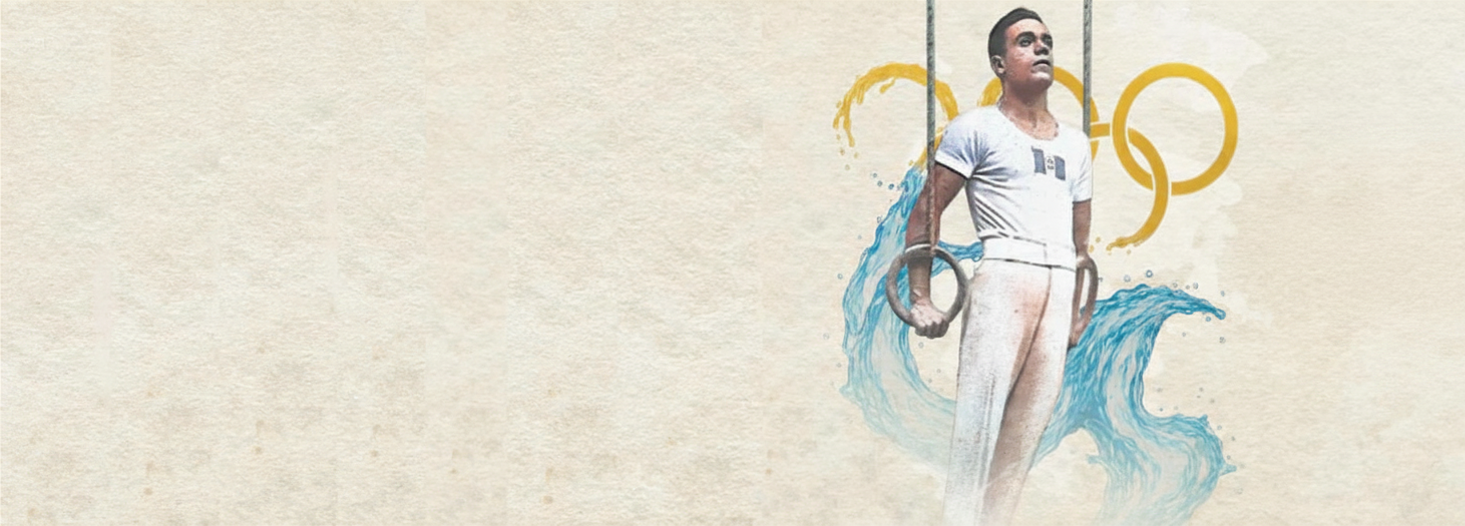
Born in Bari in 1900, Martino was one of the most prominent figures in Italian gymnastics in the early 20th century. Everyone knew him as “Ciccio”. He developed his sporting skills at the Società Ginnastica Angiulli, which he joined as a child and where he learnt, day by day, to trust his own hands. On the rings, you cannot fake it. Every position demands that the body is truly there, present, capable of holding its own. No movement can be half-hearted.
In Paris, in 1924, Martino took that discipline to the Olympic arena in Colombes. He won individual gold on the rings and, with the Italian team, also claimed gold in the team competition. Two medals in two days. There was probably someone in Bari waiting for him. Someone who read his name in the newspapers and recognised him as the lad from Angiulli.
But his story does not end on the podium. In that same year, 1924, Martino joined the then Ente Autonomo Acquedotto Pugliese as a motor mechanic. It is a fact that speaks volumes. His connection with the Aqueduct did not come as a refuge from the limelight. It began in the very same year of his Olympic glory, during a period when sport and work went hand in hand, just as practical matters do in a man’s life.
In the years that followed, Martino held various roles: the finance office, then senior mechanic and roadmender, and finally chief caretaker in 1952. He remained in service until 1960. It is not hard to picture him: that man in his forties, then fifties, then sixties, who knew every corner of the infrastructure he served, who knew where a fault lay even before looking for it. Work in the aqueduct has this quiet nature: it is visible above all when it is absent. When it works, it enters people’s lives without making a sound, like water flowing from a tap at dawn.
For us, Francesco Martino is all this too. Not just the champion. He is a colleague who has traversed decades of the history of the Acquedotto Pugliese with the same steadfastness with which he tackled the rings. A person who holds together discipline and care, results and responsibility, his own body and his own craft.
In the Palazzo dell’Acqua, the room dedicated to him gives this memory a physical home. The photographs, the archive materials, the reproductions of the medals and the commemorative plaque are not an exercise in nostalgia. They are a way of remembering that the history of a public company is also made up of the people who lived it — those we know by name and those we no longer know, but who were there.
Telling Martino’s story today is not just about looking back. It is about recognising a continuity that still makes sense. The Acquedotto Pugliese was founded to bring water to a land that needed it and continues to grapple with a fragile resource, complex networks, and communities to serve every day. In this story, those who work on the ground — those who know the pipes, the pumps, the stations — are never on the sidelines. They are part of the backbone of the service.
Francesco Martino won two Olympic gold medals. Then he carried on working. This, perhaps, is the most understated and powerful part of his story. Greatness does not always coincide with visibility. Sometimes it lies in the ability to stay in one’s place, with competence and restraint, day after day.
There is a clear thread running between the rings of Paris and the rooms of the Aqueduct. The discipline that allows an athlete to step onto the podium is the same that enables a public service to endure over time. And perhaps, deep down, it is also the same discipline that ensures that, a hundred years later, someone takes the trouble to remember.